History

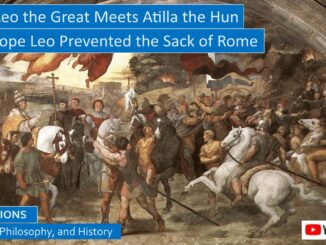
Pope Leo the Great, Confronting Attila the Hun, and His Role in Fourth Ecumenical Council of Chalcedon
Catholic Middle Ages and Beyond

Pope Leo the Great, Confronting Attila the Hun, and His Role in the Fourth Ecumenical Council of Chalcedon

As Pope Benedict XVI writes: “The times in which Pope Leo lived were very difficult: constant barbarian invasions, the gradual weakening of imperial authority in the West, and the long, drawn-out social crisis forced the Bishop of Rome” “to play an important role in both civil and political events.”
“In a period of profound crisis, Leo the Great knew how to make himself close to the people and the faithful with his pastoral action and his preaching. He enlivened charity in a Rome tried by famines, an influx of refugees, injustice, and poverty. He opposed pagan superstitions and actions of Manichaean groups. He associated the liturgy with the daily life of Christians.” […]

Did Rome Fall, or Evolve to Barbarian Kingdoms? Sack of Rome, and Attila the Hun’s Invasions
Greek and Roman History

Did Rome Fall, or Evolve Into the Barbarian Kingdoms? Sacks of Rome, and Attila the Hun’s Invasions

Peter Brown contends: “The Roman Empire was not violently breached by barbarian “invasions.” Rather, between AD 200 and 400, the frontier itself changed. From being a defensive region, which kept Romans and barbarians apart, it had become, instead, an extensive middle ground, in which roman and barbarian societies were drawn together. And after AD 400, it was the barbarians and no longer the Romans who became the dominant partners in the middle ground.” Indeed, after AD 400 barbarian tribes served in the army of the Huns, and barbarians from most of the tribes, including the Huns, served in the Roman armies. […]
Summary of Papacies Between Trent and Vatican II. How Did These Popes Prepare the Way for Vatican II?
History

Summary of Papacies Between Trent and Vatican II. How Did These Popes Prepare the Way for Vatican II?

How did the Catholic Church survive the French Revolution, the conquests of Napoleon, and the Revolutions of 1848? Was the Second Vatican Council a continuation of Vatican I? Was Pope Leo XIII, who issued Rerum Novarum, the social justice encyclical that sympathized with the working man, a conservative or a […]

Pope Benedict XV and Pope Pius XI: Confronting World War I and World War II, and Fascism
History

Pope Benedict XV and Pope Pius XI: Confronting World War I and World War II, and Fascism

Mussolini signaled in a speech that he was open to negotiating the Roman question. Mussolini was not a practicing Catholic and was famously a serial philanderer. Like Napoleon before him, Mussolini realized that it was in his political interest to settle this issue and regularize the status of the Vatican City.
O’Malley writes: “The most momentous aspect of the Lateran Agreements was the establishment of the Vatican City as a fully independent and sovereign state, with its own postal service, police force, full diplomatic corps, and so forth. The Italian state agreed never to interfere in the free functioning of Vatican City and ensured full and safe access to it by anyone the papacy wanted to receive. The papacy agreed never to try directly or indirectly to reestablish the Papal States, and it relinquished in perpetuity all claim to the city of Rome.”
The Vatican was paid a generous indemnity for the loss of this territory, and the state would pay an annual stipend for the upkeep of historical monuments. In addition to the 103 acres in Vatican City, the pope could also use several churches and castles traditionally at the church’s disposal. […]
Pope Pius X, Promoting Piety, Rejecting Modernism
History

Pope Pius X, Promoting Piety, Rejecting Modernism

After the long and momentous papacy of Pope Leo XIII, the cardinals sought a candidate who would be a pastoral pope. They chose Guiseppe Sarto, who had spent his entire priestly life as a pastor, last serving as patriarch of Venice. He was from a family of modest means, and for nine years he served as a priest in a country parish. His formal education was meager, he studied at a seminary in Padua.
Our author John O’Malley explains: “Pope Pius X had never set foot outside Italy. He saw things in terms of black and white. While still Patriarch of Venice, he wrote to a friend: ‘When we speak of the Vicar of Christ, we must not quibble. We must obey. We must not evaluate his judgments or criticize his directions lest we do injury to Jesus Christ himself. Society is sick. The one hope, the one remedy, is the pope.’ The words ring like an Ultramontanist manifesto.” […]
Pope Pius IX, 1848 Revolutions and First Vatican Council
History

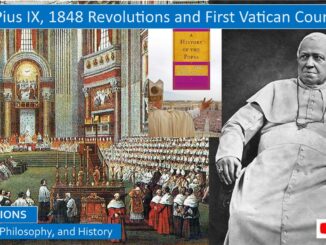
Pope Pius IX, 1848 Revolutions and First Vatican Council

Why did Pope Pius IX call the council? John O’Malley notes: “Some people speculated he wanted it solemnly to confirm the Syllabus of Errors. He may have wanted it as a show of Catholic strength worldwide against the church’s enemies, especially in Italy.”
O’Malley continues: “Despite the broad agenda that was anticipated, the council dealt with only two items. The first was the relationship between revealed truth and the powers of human reason.” The council affirmed both the distinction and compatibility between them. With that resolved, the council planned to discuss “church-state relations and the role of the bishops, but with the encouragement of Pius it bypassed them and moved directly to consider” “papal primacy and papal infallibility.”
Papal primacy was not new; the Catholic Church had held this view for fifteen hundred years. But the pope and many bishops felt that the church needed to definitively state that the pope had full authority, not only over matters of faith and morals, but also over discipline and governance for the church worldwide, for both clergy and laity. […]
Popes Between Trent and Vatican I, Including Napoleon, the French Revolution, and Pope Pius VI
History

Catholic Popes from Trent to French Revolution and Napoleon to Vatican I

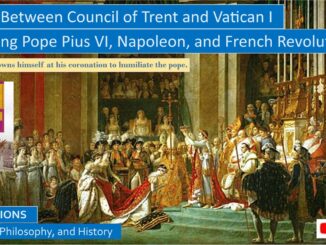
Negotiations for a Concordat between France and the Pope dragged on for thirteen months and over two dozen drafts. O’Malley writes: “Pope Pius VII and” his secretary of state “Consalvi stalled for time, intent on getting out of Napoleon every concession they could. The delay drove Napoleon crazy. He threw tantrums. He threatened to become a Protestant. He threatened to have his troops march on Rome. But finally, on July 15, 1801, the concordat was signed.”
What were the terms of the concordat? Although it acknowledged that most French were Catholics, there was freedom of religion, and Catholicism was not the state religion of France. O’Malley notes: “The buildings and real estate seized from the church during the Revolution were to remain in the hands of the new owners, but cathedrals and churches needed for worship were put at the disposal of clergy as needed. The clergy, who must swear to uphold the government, were paid by the state, which is the first time in history for such a provision.” It reaffirmed that “the state had the right to nominate bishops, subject to the approval of the papacy.” […]
Summary of Youth and Military Career of Ulysses S Grant
Civil War Memories

Summary of Youth, West Point, and Generalship of Ulysses S Grant, From Mexican-American War to Civil War

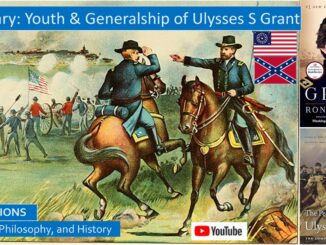
Those who fought the Civil War grew up in the America of Andrew Jackson, when the giants of the second generation of American leaders fought to hold the United States together. These great orators, including Henry Clay and Daniel Webster, would later inspire Union soldiers to fight and die to preserve the Union. These were the years when the slave-owning Southern President Andrew Jackson threatened to deploy federal troops to prevent the secession of South Carolina over tariffs during the Nullification Crisis in the 1830s. […]
General Ulysses S Grant’s Victory at the Bloody Battle of Shiloh, and His Earlier Civil War Battles
Civil War Memories

General Ulysses S Grant’s Victory at the Bloody Battle of Shiloh, and His Earlier Civil War Battles

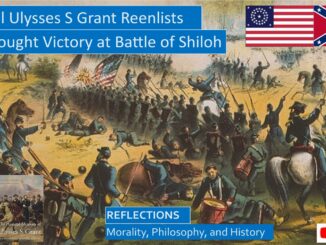
Chernow recounts: “Before Shiloh, Grant had nursed hopes for a titanic battle that would triumphantly crush the rebellion. Now, stunned by the combative spirit of his foes, he knew there would be many more bloodbaths in a long, grinding war of attrition. This began is conversion to a theory of total warfare in which all of southern society would have to be defeated.”
Chernow continues: “For Grant, Shiloh represented a personal victory. He had rescued his army from his own errors, showing a gumption and an audacity that altered the battle’s course. He had shown coolness under fire and a willingness to take monumental gambles. The battle also instilled lasting confidence in the Army of the Tennessee, shattering anew the fighting mystique of rebel soldiers.” […]

Early Life and Career of Ulysses S Grant Through His Service in the Mexican American War
Civil War Memories

Early Life and Career of Ulysses S Grant Through His Service in the Mexican American War

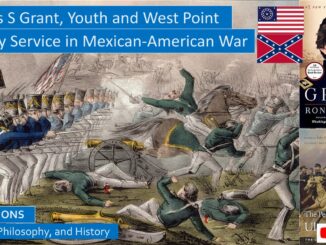
What was young Ulysses like? Chernow says that in his youth, Ulysses “seemed forgettable and colorless,” was not wayward or rambunctious or mischievous. “Like his mother, he was self-contained, as if he had trained his face to mask emotion and keep his inner life secret. Like Hannah, he was uncommonly even-tempered.” Unlike many great men of history, Ulysses in his youth had no vision of a great future and was prepared to live his life in obscurity. He was underestimated by many who met him.
Chernow describes traits that would serve him well later in life. “Never one to initiate a fight, he refused to back down when bullied. He was roused to fury if sadistic boys tormented an innocent child or a defenseless horse, and small boys embraced him as their steadfast protector.”
Ulysses was born with a love for horses. Chernow notes: “He liked to ride without a saddle or stirrups, sitting astride a blanket on the horse’s back, and he was so expert at handling horses that he began riding at age five. He became known for breaking in wild horses for local farmers.” “He tamed even the most refractory horses through a fine sensitivity to their nature rather than by his physical prowess.” […]

JRR Tolkien’s Lord of the Rings: How Was It Influenced by Nordic Mythology and Catholicism
History

JRR Tolkien’s Lord of the Rings: Was It Influenced by Nordic Mythology, Homer’s Iliad, and Catholicism?

What inspirations did JRR Tolkien draw from for his best-selling series The Lord of the Rings, and the Hobbit? Like his friend CS Lewis, Tolkien was an English Professor specializing in medieval and ancient literature and languages. When CS Lewis was contemplating whether to return to his Episcopalian roots, abandoning his youthful agnostic views, Tolkien argued that he should convert to Catholicism. CS Lewis resisted these pleas. IMHO, though CS Lewis was conducive to Catholicism, and may have even confessed his sins to a priest, he likely thought he would be more effective evangelizing through his books as an Episcopalian.
Both JRR Tolkien and CS Lewis fought in the trenches in France as British soldiers during World War I, they both lost many friends who fought beside them: they both experienced the horrors of war. Both were too old to serve in World War II, but this struggle against the evils of Naziism directly influenced CS Lewis’ Mere Christianity and Tolkien’s Lord of the Rings, both released shortly after the war. […]

Who Were More Violent: Black Civil Rights Protestors or White Supremacists?
Civil Rights

Who Were More Violent: Black Civil Rights Protestors or White Supremacists?

We had a recent comment on the somewhat peaceful protests organized by Martin Luther King and other civil rights leaders during the tumultuous decade of the Sixties: “They were violent rioters, not peaceful protesters.” How violent were these protesters, and how violent where the white supremacists they were confronting? And […]

Jimmy Carter, Raising Crops and Livestock, and Health and Hygiene, in Rural Georgia During the Depression
Civil Rights

Jimmy Carter, Raising Crops and Livestock, and Health and Hygiene, in Rural Georgia During the Depression

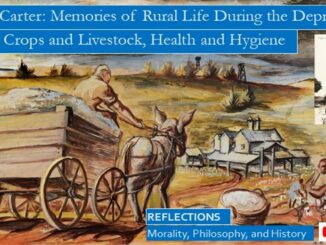
Although both blacks and whites experienced health and hygiene challenges during the Depression, poor health was more prevalent among black laborers and sharecroppers. Jimmy Carter remembers: “The life expectancy of black men and women was less than fifty years.” “During most of the year, they ate only two meals a day, usually cornmeal, fatback, molasses, and perhaps sweet potatoes. The more industrious families also had small gardens that provided some seasonal corn, Irish potatoes, collards, turnips, and cabbage, with a few rows of peas and beans planted alongside the garden fence. The combination of constant and heavy work, inadequate diet, and excessive use of tobacco was devastating to the health of our poorer neighbors.” His mother encouraged her black neighbors to grow vegetables in their own gardens, and shared with them the vegetables from the Carter family garden. […]

Jimmy Carter, Memories of Sharecropping, Civil Rights, and Life in Rural Deep South Georgia
Civil Rights

Jimmy Carter, Memories of Sharecropping, Hoboes, New Deal, and Civil Rights in Rural Georgia

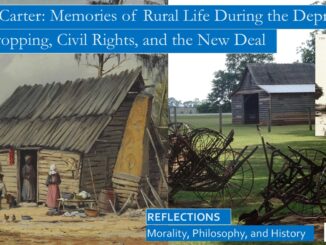
“There was an issue that troubled my mother during my political years, when the news media began to probe our family’s history. One day she said to me, “Jimmy, one thing bothers me. Reporters have criticized your daddy lately about not being for racial integration. What they don’t recognize is that he died in 1953, when there was no such thing as integration, and nobody had ever heard of Martin Luther King or any civil rights movement. Your daddy always rejected all the racist organizations that degraded or persecuted black people, and both races always knew him to be fair and helpful. I was real controversial in the community sometimes, but he supported everything I did to help black people and to treat them well.” […]

Jimmy Carter: Christmas in Plains Compared to Christmas in the White House and Afterwards
Current Events and History

Jimmy Carter: Christmas in Plains Compared to Christmas in the White House and Afterwards

Jimmy Carter grew up on his family farm in Archery, Georgia, several miles from Plains. He remembers: “In those earlier days, all my close neighbors were black families.” Their children “were my intimate friends with whom I played, fought, fished, hunted, and worked with in the cotton and peanut fields that were owned by my father.” When he went into town to sell peanuts, and when he started school, he felt that he “was in an alien environment in Plains, away from my black friends.”
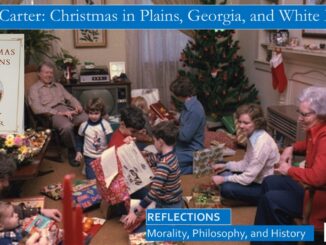
Jimmy Carter continues: “The Great Depression was a time of almost incredible poverty, not only in rural Georgia but all over the country. Although my father was a landowner, cash money was scarce for us and for everyone else. Land seemed to have the only permanent economic value, and hard work was the key to survival. The celebration of Christmas during these times was quite different from what we know today: much more frugal, but with a degree of personal intimacy that brings back warm recollections.” […]

Jimmy Carter Biography Presidency Carter Center
Abortion

Jimmy Carter, His Presidency, and Founding the Carter Center

Jimmy Carter was elected as President when many voters wanted an honest President after the nation witnessed the Watergate scandal and coverup by a criminal president who was facing impeachment. Not only was Jimmy Carter seen as an honest man, but he was also a sincere born-again Christian. But his support for civil rights turned many white Christians against him. In the introduction, Jimmy Carter proclaims: “Vice President Mondale summarized our administration by saying, ‘We told the truth, we obeyed the law, we kept the peace.’ I would add, ‘We championed human rights.’” […]

Jimmy Carter's Youth and Navy Years: From Plowing With Mules to Nuclear Submarines
Civil Rights

Jimmy Carter’s Youth and Navy Years: From Plowing With Mules to Nuclear Submarines

While Jimmy Carter was transitioning from a technologically demanding naval career working with nuclear submarines to move back to rural Georgia, where farms had yet to transition from mules and horses to tractors, rural Georgia was also experiencing the same racial transitions that the military was dealing with. The year after his retirement, the Supreme Court issued the Brown decision, mandating that public schools be desegregated with all deliberate speed. […]

Why Did Trump Win? What Should Democrats Do Now?
Current Events and History

Why Did Trump Win? What Should Democrats Do Now?

Trump’s only path to victory in 2024 was to continue stirring up the hate and prejudice that won him the election in 2016. Simply put, more Americans approved of Trump’s divisive message than disapproved. Trump’s question to black journalists: When did Kamala Harris turn black? may have been more calculating than it seemed. Since Kamala Harris could pass for white, Trump wanted to hammer home the message to his base that Harris was as black as a burnt black kettle.
In this past election, we learned that many older white voters who will vote for an old boring white guy will never vote for a younger black woman, whether she could pass for white or not. Joe Biden won in 2020 because he was an old boring white guy with significant support from black voters. Unfortunately, in 2024 black and liberal voters did not turn out in sufficient numbers to tip the balance. My gut feeling is that a Tim Waltz-Kamala Harris ticket would have won, but that was a political impossibility given the short time frame needed to swap the candidates. After Biden’s disastrous debate performance, he was not seen as a winner.
Again, do not forget that half the country lives in the news bubble dominated by right-wingnut media, including Fox News, Newsmax, Breitbart, Steve Bannon’s podcast, and Alex Jones, that lie with abandon. […]

Eugenics Under Jim Crow America and Nazi Germany: Sterilization, Euthanasia, Lynchings, and Holocaust
Civil Rights

Eugenics and Scientific Racism in the Jim Crow Deep South and Nazi Germany

Was there a similar Final Solution in America? True, there were no gas chambers in the Deep South, nor was there a similar system of systematic mass murder, but there were riots such as the Tulsa Riots where the homes, businesses, and churches of thousands of blacks were torched and looted, and many blacks were injured and murdered. In these riots, mostly occurring in many cities during the interwar years, on rare occasions when there were police arrests, they arrested the black victims who fought back. The major difference is that the Nazis murdered far more people much quicker, and their regime lasted only a decade, as opposed to the seventy-year reign of Jim Crow racism in America. […]

Philosophy and Psychology

Book Reviews and Miscellaneous

My Favorite Reflections on Morality, Philosophy, and History

Scholars, like most everyone else, are social creatures, and are eager to please their teachers. This means they usually repeat the narratives they have been taught. Additionally, professors are often so hyper-specialized that they overlook connections to other fields. And, as Professor Steven Pinker noted, back in the day, professors dared not study consciousness until they attained tenure.
Is there anything new under the sun? What I hope to find is someone from the past who confirms my insights, because original insights are most valuable when they are old truths long forgotten, or connections are overlooked because prior generations were blind to how current events affected their views. Even when there is no direct confirmation, I sometimes find reflections from past generations that indirectly confirm, or at least do not disprove my perspectives.
For me, creativity is not a problem, so I prefer to include quotes from ancient and modern authors, to encourage my listeners to read them on their own. Why restate aphorisms in my own words when they are so inspiring when originally uttered? The eastern Church Fathers did not see a need to reword inherited ancient teachings, so why should I? […]

Criminology

Sunrise Community Police Academy: Police and Mental Health, Canine Officers, 911 Call Center

On homicide week in our Sunrise Community Police Academy, the police instructor showed us the ghoulish face of a dementia patient found face down in a canal. The officer commented that for some strange reason, dementia patients have a strange attraction to water, often drowning.
Roughly sixty percent of dementia patients wander. Experts note that when someone suffering from dementia wanders away, one in four will lose their lives if they are not found within two days. This is why police urge citizens to report a missing person sooner rather than later. […]

Cicero on Friendship and Virtue
Philosophy

Roman Stoic Philosopher Cicero On Friendship and Virtue

Cicero advises us: “The first and sacred law of friendship: Seek only good from friends, do only good for the sake of friends, and don’t wait to be asked! Be always attentive! Banish hesitation! Be ready to give advice freely! Take seriously the good advice of friends. Be ready to offer it openly, even forcefully, if the occasion demands, and also be ready to follow when it has been offered.”
In contrast, Antisthenes, the first Cynic philosopher who studied under Socrates, advises us: “Pay attention to your enemies, for they are the first to notice your faults.” Often, friends are reluctant to tell us what we need to know, preferring to tell us what they think we want to hear. […]

Sunrise Police Academy 2 SMALL
Criminology

Sunrise Community Police Academy: What is New? Cameras, Technology, Guns, SWAT Team, and More

Caution is a policeman’s main defense against bullets headed their way. Police are rarely in a rush to approach the driver during a traffic stop, nor are they in a rush to knock on the door for a domestic dispute call. If possible, they wait until other policemen arrive. The more backup, the better.
I was surprised to learn how policemen respond to other police pulling them over when they are in other jurisdictions. They politely roll down their windows, put their hands on their steering wheels, and tell them that they too are police officers. They volunteer where they have their guns, which all policemen carry. They don’t put any documentation in the glove box, because they don’t want to reach in to grab it. […]

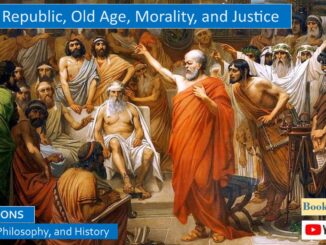
Plato’s Republic, Book 1, Reflecting on Old Age, Morality, and Justice
Aging

Plato’s Republic, Book 1, On Aging and Morality, a Better Word for Justice

Reading Robin Waterfield’s translation was like breathing fresh alpine air. When I thought that Plato’s Republic was about justice, I reasoned that this was because Socrates sought to train Athenians to be better citizens in a direct democracy, a skill that would not be needed in the later totalitarian Roman Empire. But Robin Waterfield’s translation of the Republic makes more sense and is more in line with Stoic and Christian moral values. I demur from the conventional scholarly opinion that who the translator is does not matter. […]

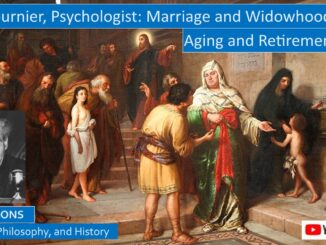
Paul Tournier, Christian Psychologist on Marriage and Widows in Old Age and Retirement
Aging

Paul Tournier, Christian Psychologist on Marriage and Widows in Old Age and Retirement

What is the ideal, according to Paul Tournier? “Growing old together, husband and wife can come to know a love which is, in a way, a prefiguration of heaven, for it is less tumultuous than the love of youth, being less directed towards selfish pleasure-seeking, and because a slow advance in mutual comprehension permits more authentic communication.” […]

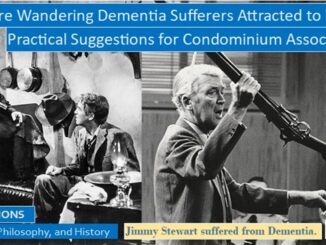
Why Are Dementia Patients Who Wander So Drawn to Water? Why Do They Drown?
Dementia and Alzheimers Disease

Why Are Wandering Dementia Patients Drawn to Water? Why Do They Drown?

The biggest objection property managers and association boards raised against performing health and wellness checks on their owners and residents is they are not nursing homes: they do not want to be held responsible for the welfare of their owners and residents. But even if they wanted to, they cannot take on the responsibility of care. Instead, they should call the police and request that they conduct a health and wellness check. They should inform the police about the possible foreclosure of a dementia patient, as this will better enable them to receive any care they may need. Any known family members must also be informed.
Alternatively, or additionally, they can request that the Broward County Council of Aging, or an appropriate local agency, refer the case to a professional. The Alzheimer’s Association 24/7 support hotline at 800-272-3900 is also an excellent resource. […]

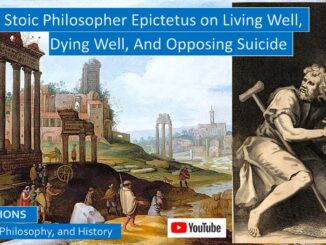
Epictetus, Eminent Roman Stoic Philosopher, on Living Well, Dying Well, and Opposing Suicide
Aging

Epictetus, Eminent Roman Stoic Philosopher, on Living Well, Dying Well, and Opposing Suicide

Is it wise to complain? Epictetus observes: “If someone dies young, he blames the gods because he is being taken before his time. If someone lingers on into extreme old age, he too blames the gods.” “Despite this, at the approach of death, he wants to stay alive; he sends for the doctors and begs him to do all he can.” “It is quite remarkable to see how people want neither to live nor to die.”
“Is health good and illness bad? No, man. What, then? Health managed well is good, but when badly managed, it is bad.”
Epictetus points out: “If you look at yourself in isolation, it is natural for you to live to an old age, to be rich, to be healthy. But if you look at yourself as a human being and as part of some whole, for the sake of that whole, it may be appropriate for you to be ill, or risk your life at sea, or be poor, or die young. Why get angry then?” “What is a human being? A part of a city made up of gods and human beings,” “a small copy of the universal city.” […]

Doris Day, Que Sera Sera, Que Sepa Sepa
Aging

Doris Day, Everyone’s Girl Next Door: Que Será, Será? Que Sepa, Sepa?

Doris Kappelhoff was born in 1922, she was both a leading movie star and singer from the 1940’s through the early 1960’s, when many movies were musicals. In her youth she was hoping to be a dancer, but when she broke her leg when the car she was riding in collided with a freight train, she instead became a singer. She started singing in the hospital out of boredom, and since her voice was so clear her mother enrolled her in voice lessons.
In the late thirties Doris began her career as a big band singer, recording more than six hundred songs. Early in her career she adopted the stage name of Doris Day, inspired by the song Day After Day, as her original surname was too long to fit on marquees. She made her film debut in 1948, starring in dozens of movies with many leading men of Hollywood, many of them romantic comedies, including Rock Hudson, Jimmy Stewart, Clark Gable, Ronald Reagan, Cary Grant, David Niven, and many others.
Her public persona was the virtuous girl next door, so she declined the leading role in the Graduate. In that movie, the role of the randy mother-in-law went to Ann Bancroft, who seduced her future son-in-law, Dustin Hoffman. What was not explored in the movie was what the family holiday dinners were like after he married her daughter. Doris Day was not willing to transition to the Free Love climate of the Sixties, which quickly ended her movie and recording careers. […]

Roman Stoic Philosopher Cicero on Aging and Death
Philosophy

Roman Stoic Philosopher and Politician Cicero on Aging and Death

Cicero advises us: “Enjoy the blessing of strength while you have it, and have no regrets when it has gone, any more than young men should regret the end of boyhood, or those approaching middle age lament the passing of youth. Life’s course is invariable: nature has one path only, and you cannot travel along it more than once. Every stage of life has its own characteristics: boys are feeble, youths in their prime are aggressive, middle-aged men are dignified, while the elderly are mature. Each of these qualities is ordained by nature for harvesting in due season.”
Cicero continues: “Age must be overcome; its faults need vigilant resistance. We must combat them as we should fight a disease: following a fixed regime, exercising in moderation, and consuming enough food and drink to strengthen” but not too much. “The mind and spirit need even more attention than the body, for old age easily extinguishes them, like lamps” with too little oil. […]

Seneca on Aging Death and Suicide
Aging

Roman Stoic Philosopher Seneca on Aging, Death, and Suicide

Seneca reminds us: “There is indeed a limit fixed to us,” “but none of us knows how near he is to this limit. Therefore, let us so order our minds as if we had come to the very end. Let us postpone nothing. Let us balance life’s account every day.” “Let us begin at once to live and count each separate day as a separate life.” What is important is “not how long you live, but how nobly you live. And often living nobly means that you cannot live long.” […]

Roman Stoic Philosopher Seneca on Aging, Retirement, and Death
Aging

Roman Stoic Philosopher Seneca on Old Age and Retirement

Seneca faces old age and death as only a Stoic could. “Old age is a time of life that is weary rather than crushed.” Nevertheless, I am thankful, “for age has not damaged my mind, though I feel its effects on my constitution. Only my vices” “have reached senility; my mind is strong,” “it is alert,” “it declares that old age is when it blooms.” “My mind bids me to consider how much this peace of mind and moderation of character I owe to wisdom and how much to my time of life; it bids me to distinguish carefully what I cannot do and what I do not want to do.” “There is only one chain that binds us to life, and that is the love of life.” […]

Classical Christian Psychologist Paul Tournier on Old Age, Death, and Faith
Aging

Classical Christian Psychologist Paul Tournier on Old Age, Death, and Faith

Tournier reminds us that we may experience many successes, but as we grow older, “success retreats, and escapes us, it is limited, unfulfilled.” “When one comes to the end, a man’s life is nothing much.” “Professional life is over, and it finishes unfinished. This is a prefiguration of death, in which the whole of life will finish it, too, being unfinished. That is the dramatic contradiction of death.” Quoting Robert Mehl: “An end, but not a fulfilment, that is the face of death.” […]

Paul Tournier on Aging and Retirement
Aging

Classical Christian Psychologist Paul Tournier on Old Age and Retirement

Paul Tournier notes: “Freud defined psychological health under the double heading of aptitude for love and for work.” But Paul Tournier cautions that “the superficial relationships of working life and of sexual attraction must lead to a deeper personal commitment. And I believe that no commitment can be truly personal unless it takes on a transcendent dimension and become love, in the biblical meaning of the word.”
Paul Tournier is grateful: “As an intellectual, I am specially privileged. It is true that the better educated people are, the more chance they have to enjoy their retirement. First, intellectual work” is not physically taxing. “Second, the capacity for intellectual work is retained longer than physical ability. It can even increase in old age as long as disease does not affect the mental faculties. But most of all, the more one exercises one’s mind, the more pleasure it gives to exercise it. The more one learns, the more one wants to learn, and the easier study becomes.” […]

St John Chrysostom, Voltaire, and Leibniz Ask: Why Would a Loving God Permit Earthquakes?
Early Church Writing

St John Chrysostom, Voltaire, and Leibniz Ask: Why Would a Loving God Permit Earthquakes?

Theodicy is the term that Gottfried Leibniz coined in 1710 to describe this so-called problem of how an Almighty God permits suffering in the world.[1] The famed textual critic Bart Ehrman describes how he lost his faith over his concern about Theodicy in his book, On God’s Problem: Why We Suffer. As he points out, different books of the Bible answer this question differently. Many of the prophets, like St John Chrysostom, proclaim that natural disasters are often punishment meted out because we do not take care of the widows, orphans, and the poor.
On the other hand, in the Book of Job God does not give a reason for Job’s suffering, instead asking if Job can fathom the purposes of any of God’s inscrutable actions. why God permits the actions of God.  Although I often do not agree with Bart Ehrman’s conclusions, I rarely disagree with the evidence he cites in his works. Another recent best seller is by Rabbi Harold Kushner: When Bad Things Happen to Good People. We plan to reflect on both these works sometime in 2025. […]

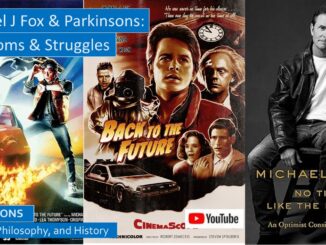
Michael J Fox and Parkinsons: Symptoms and Struggles
Philosophy

Michael J Fox and Parkinson’s Disease: His Symptoms and Struggles

Where does Parkinson’s disease fall on the spectrum of neurological diseases? On one extreme, dementia, including Alzheimer’s disease, degrades the patient’s cognition, including memory and reasoning. Their motor functions decline only as their overall health declines. On the other extreme, ALS or Lou Gehrig’s disease degrades the patient’s motor functions, often starting with the legs, then the arms, then they have trouble breathing. […]

Tamara Dawes, On Sex Trafficking and Homelessness, Rotary Club of Sunrise FL Speaker
Philosophy

Tamara Dawes, On Human Trafficking and Homelessness, Rotary Club of Sunrise FL Speaker

I’m just a mom that has seen families sleeping in cars, on plazas, and numerous other places with nowhere to turn. Recently, I had a brief encounter with a single mother and her sixteen-year-old son; they were on a plaza with two small black bags containing all their possession asking for money to buy food. The security guard approached and asked them to vacate the premises, because people were complaining about their presence, and she didn’t want to call the police. The kind security guard allowed me to get some personal information from this mother whom I tried to help. The desperate mother related how frustrated she was in her hopeless attempts of trying to find accommodations, as the shelters are unable to accept them because of the Covid-19 mandate that limits their capacity. I informed her that I too have made numerous calls, so I can attest to the information she shared. […]

What are the Ten Early Signs and Symptoms of Alzheimer's?
Dementia and Alzheimers Disease

What are the Ten Early Signs and Symptoms of Alzheimer’s?

What are the Ten Early Signs and Symptoms of Alzheimer’s? We repeat these ten warning signs from the Alzheimer’s Association website in our book review of Kim Campbell’s biography of the celebrity country music star Glen Campbell from before his diagnosis of Alzheimer’s disease through his passing. We reflected on […]

Did Pythagoras Influence Plato? How Mathematics and Music Reveal the Divine Order
Greek Philosophy

Did Pythagoras Influence Plato? How Mathematics and Music Reveal the Divine Order

Diogenes concludes that “the most important aspect of human life, according to Pythagoras, is the power to persuade the soul towards good or evil. Men who acquire a good soul are blessed,” while evil men “are never at rest,” nor can they keep to the narrow path. “Justice has the force of an oath, which is why Zeus is called the God of Oaths. Virtue is harmony and health and goodness in its entirety and god itself.” The universe is governed by “the laws of harmony. Friendship is harmonious equality.”
Diogenes then shares Pythagoras’ instructions for purification, some of which resemble the ancient Jewish laws. “Purity is attained by cleansing, ablution, and sprinkling with lustral water, and by avoiding all contact with cadavers, women in childbirth, and that defiles,” and beans and eggs and other forbidden foods. […]

Meno, a Platonic Dialogue. Why did Xenophon Despise Meno?
Philosophy

Meno, a Socratic Dialogue. Why Did Xenophon and Plato Despise Meno? How Did Meno Die?

Xenophon, in Robin Waterfield’s translation, remembers:
“It was obvious that Meno longed to be rich; he wanted military command because it would bring him a greater share of the spoils, he wanted prestige because it would help him increase his wealth, and he wanted to be on good terms with the most powerful men because then he could avoid being punished for his crimes.”
Xenophon continues, “Meno thought that the quickest way for him to achieve his goals was to use perjury, lies, and deceit. In his opinion, openness and truthfulness were synonyms for stupidity. He evidently felt no affection for anyone, and if he claimed to be somebody’s friend it soon became clear that he was trying to sabotage him.”
Xenophon said that “Meno was frightened of people he found breaking promises and committing crimes, because he regarded them as well protected, and he tried to exploit people who were moral and honest because he regarded them as weak.” […]

Morality

Protestantism, Catholicism, Orthodoxy, and Judaism: Which Is True
christianity

Protestantism, Catholicism, Orthodoxy, and Judaism: Which Is True?

We agree with CS Lewis when, in his Preface to Mere Christianity, he states that “the reader should be warned that I offer no help to anyone who is hesitating between two Christian denominations. You will not learn from me whether you ought to become an Anglican, a Methodist, a Presbyterian, or a Roman Catholic.” CS Lewis compares his Mere Christianity to a central hall opening up to many rooms, representative of the various denominations, saying that this hall is a place to wait while you try the different doors.
CS Lewis continues: “There is no mystery of my own position. I am a very ordinary layman of the Church of England, not especially high, nor especially low, nor especially anything else.” […]

Homosexuality, the Bible, and the Church: The Zondervan Debates
christianity

Homosexuality, the Bible, and the Church: The Zondervan Debates

For better or worse, most of us choose our intimate partners, and build our world around that choice. If a homosexual couple is accepted by the clergy of your church, what good can come from telling them they are going to burn in hell if they do not repent? We are only responsible for our own personal salvation, it is not our job, particularly if we are laymen, to speculate on whether our neighbor will be saved. That is between them and Jesus, and nobody else.
My goal is not to change your mind about homosexuality. My goal is: If you do not accept that it is possible to be both a Christian and homosexual, that you will refrain from telling them they are damned to burn in hell, but would instead refer them to an Episcopalian Church, or other church where they would be welcome.
Jesus will judge us all in front of the great IMAX theater in the sky, where we will need to account for the decisions we made in our lives as they are displayed on that screen forty feet wide and forty feet tall. Jesus is the judge; we should not seek to do his job. Instead, we work out our own salvation, judging our own actions rather than our neighbors’. […]

Joys of Successful Aging, by Evangelical George Sweeting, Moody Bible Institute
Aging

Joys of Successful Aging, by Evangelical George Sweeting, Moody Bible Institute

George Sweeting writes: “Age adds maturity and richness to life. Age smooths the rough edges of life and adds gentleness and compassion. They say: ‘The older the violin, the sweeter the music.’ Some speak of seniors as ancient, faded, frail, shriveled, senile, withered, wrinkled, and worthless!” I prefer to say seniors are “experienced, dependable, mature, patient, seasoned, steady, wise, tested, survivor, and veteran!” […]

Opposing Suicide: According to the Bible, Catholic Catechism, and St Augustine’s City of God
Command 6 Do Not Murder

Opposing Suicide: Biblical Exhortations, Catholic Catechism, and St Augustine’s City of God

CCC 2281. “Suicide contradicts the natural inclination of the human being to preserve and perpetuate his life. It is gravely contrary to the just love of self. It likewise offends love of neighbor because it unjustly breaks the ties of solidarity with family, nation, and other human societies to which we continue to have obligations. Suicide is contrary to love for the living God.” […]

The Decalogue in the Torah and the Book of Legends, Do Not Steal
Command 7 Do Not Steal

The Decalogue in the Torah and the Book of Legends, Do Not Steal

The rabbis in the Book of Legends, which are moral excerpts from the Talmud, teach that there are four kinds of men:
The average man, like those in Sodom, who says, “Mine is mine, and your is yours.”
The ignorant man who says, “Mine is yours, and yours is mine.”
The pious man who says, “Mine is yours, and yours is yours.”
The wicked man who says, “Yours is mine, and mine is mine.” […]

St George the Dragon Slayer, From the Golden Legend and Butler’s Lives of the Saints
Lives of Saints

St George the Dragon Slayer, From the Golden Legend and Butler’s Lives of the Saints

Dacian then sought to trick St George with persuasion, and our saint played along. St George was led into a pagan temple where the people expected he would sacrifice to the gods. “But instead of sacrificing, St George knelt and prayed for the Lord to destroy the temple and all its idols, and destroy it so completely that, for the glory of God and the conversion of the people, absolutely nothing was to be left. At once fire fell from heaven and burnt the temple, its idols and priests, to a cinder, and the earth gaped open and swallowed up the remains.” […]

Book Reviews: Golden Legend, Butler’s, OCA, and Pope Benedict XVI’s Lives of Saints
Book Reviews and Miscellaneous

Book Reviews: Golden Legend, Butler’s, OCA, and Pope Benedict XVI’s Lives of Saints

The compiler of the Golden Legend was the Dominican friar Jacobus de Voragine. The Dominicans historically have been concerned about historical accuracy to guard the faith against heresy. He lists as his three primary sources the lives from Ecclesiastical History by Eusebius, bishop and advisor to Emperor Constantine; the Tripartite History by Cassiodorus; and the Scholastic History by Peter Comestor. In addition, he refers to more than 120 other sources. He was also influenced by earlier collections of lives of the saints by two other Dominican scholars. When his sources were apocryphal and not trustworthy, he points this out. When possible, he tries to reconcile dates and details, but is more concerned with the spiritual lessons than historical accuracy. […]

Pope Leo XIV, First American Pope, Successor to Pope Francis and Social Justice of Pop Leo XIII
Modern Catholic Popes

Pope Leo XIV, First American Pope, Successor to Pope Francis and Social Justice of Pope Leo XIII

Pope Leo XIV notes: “What is striking about these two attitudes is their relevance today. They embody notions that we could easily find on the lips of many men and women in our own time, even if, while essentially identical, they are expressed in different language.”
“Even today, there are many settings in which the Christian faith is considered absurd, meant for the weak and unintelligent. Settings where other securities are preferred, like technology, money, success, power, or pleasure.” […]

Pope Francis Autobiography SMALL
Modern Catholic Popes

Pope Francis’ Autobiography: Be Compassionate to the Poor and Marginalized

Pope Francis concludes his autobiography: “To learn to live, we must all learn to love. Let us not forget this! This is the most important lesson we can learn, to love, since love conquers all. By loving we can pull down barriers, we can win battles, we can defeat indifference and hate, we can melt and transform hearts.” “A disinterested love can change the world and the course of history. How many things would have gone differently if love and prayer had motivated us, rather than the thirst for power. Remember, the world need prayer more and more!” […]

The Boy in the Striped Pajamas- Does This Children’s Book Whitewash the Horrors of the Holocaust
AntiSemitism

The Boy in the Striped Pajamas: Does This Children’s Book Whitewash the Horrors of the Holocaust?

My deeper objection to this book is the thought that the young son of the commandant could be so naïve that he would not realize that making a friend of a Jewish boy would be seen as repugnant. The reality was that anti-Semitism was a core belief of the Nazi state, and this was an important virtue that the Nazi engrained in the lessons taught to impressionable youngsters both in the Nazi Youth clubs and in the public school system. Furthermore, children were taught that the Nazi virtues prohibited them from associating with Jews. […]

Parable of Lazarus and the Rich Man: Church Fathers, Reformers, and Commentators
Bible Stories and Parables

Parable of Lazarus and the Rich Man: Church Fathers, Reformers, and Commentators

James Boice teaches us: “It is true that the rich man’s riches worked to his hurt, for he lived for those and nothing else. It is hard for the rich to enter heaven, as Jesus said elsewhere in Luke. It is also true that Lazarus’ poverty worked to his spiritual good, for lacking earthly joys and comfort he turned his eyes to heaven and sought divine consolation.”
James Boice remarks on the contrasts in the parable. Spiritually, “the rich man was actually poor, and the poor man was actually rich. This contrast continues after their death: the poor rich man grew poorer, and the rich poor man grew richer.” “The final contrast is between the hopelessness of the rich man’s condition after death and the hopefulness of his condition before. After death there is no possibility of change, but in this life there is.” […]

St John Climacus, Ladder of Divine Ascent Steps 16&17 Avarice and NonPossessiveness
Ladder of Divine Ascent

St John Climacus, Ladder of Divine Ascent, On Avarice and Non-Possessiveness, Steps 16 & 17

Avarice is the worst kind of drought and famine, for it is drought and famine in the midst of plenty. A Jewish story tells of a man taken on a tour of Hell, where he sees a huge banquet hall, with long tables lined with souls, each one ogling their plate heaped with roast beef, sausage, breads, fruits and pies. This sumptuous meal tormented each one, all were starving, for they had no elbows to feed themselves. Then he was shown the banquet hall in Heaven, same type of banquet hall, same meats, breads, fruits and pies, but here the mood was joyous. Like those souls in Hell, they had no elbows, but they were joyous because they were feeding each other. […]

St John Chrysostom On Reading Scriptures, Preaching, and Chariot Races
Eastern Church Fathers

St John Chrysostom On Reading Scriptures, Preaching, and Chariot Races

“What are you saying, man? That attending to the Scriptures is not for you, since you are surrounded by a multitude of cares? Rather it is for you more than them. Monks do not need the help of the divine Scriptures as much as those who are involved in many occupations. The monks, who are released from the clamor of the marketplace and have fixed their huts in the wilderness, who own nothing in common with anyone, but practice wisdom in the calm of that quiet life, as if resting in a harbor, enjoy great security; but we, as if tossing in the midst of the sea, driven by a multitude of sins the continuous aid of the Scriptures.” […]

St John Chrysostom: Lazarus and the Rich Man: When Are the Poor Unworthy? On Wealth and Poverty
Bible Stories and Parables

St John Chrysostom: Lazarus and the Rich Man: When Are the Poor Unworthy? On Wealth and Poverty

St John Chrysostom entreats us: “The poor man has one plea:” “Do not require anything else from him; but even if he is the most wicked of all men and is at a loss for his necessary sustenance, let us free him from hunger.”
“Christ also commands us to do this, when He said, ‘Be like your Father in heaven, for He makes His sun rise on both the evil and the good, and sends rain on the just and on the unjust.’ The alms giver is a harbor those in necessity:” “whether they are bad or good or whatever they are who are in danger.”
A virtuous almsgiver is not a judge. “Charity is charity when we give it even to the unworthy.” “Need alone is the poor man’s worthiness.” “For if we investigate the worthiness of our fellow servants, God will do the same for us.” […]

Did May Give Birth to Jesus in a Cave With a Midwife? Infancy Gospels of James and Pseudo-Matthew
Bible Stories and Parables

Did Mary Give Birth to Jesus in a Cave With a Midwife? Infancy Gospels of James and Pseudo-Matthew

The Infancy Gospel of James was well known by the early Church Fathers, especially Origen, and possibly Clement of Alexandria. Although this infancy narrative was condemned by Pope Innocent I in 405 and was considered apocryphal by the Gelasian Decree around the year 500, it was one source of the early church tradition of the perpetual virginity of the Virgin Mary, Theotokos, Mother of God. It was especially treasured by the faithful in both the ancient and medieval worlds. St Jerome even speculated that Joseph was also perpetually virgin, and that the Hebrew word translated as his sons were actually his cousins.
Should we reject the Infancy Gospel of James as apocryphal? Would it be fair to label them as heretical? Although this infancy gospel contains many fanciful stories, there are no obviously heretical teachings, nor are the actions by anyone in the Holy Family morally or doctrinally objectionable. Rather, they are similar to the many Jewish midrash Talmudic stories, many of which are similarly fantastic, but are instead cherished for their moral teachings. Indeed, they wouldn’t be midrash if they weren’t improbable. […]

Should You Leave Your MAGA Church? Or Should You Choose To Stay?
Current Events and History

Should You Leave Your MAGA Church? Or Should You Stay?

Rev Trevors does not address the common situation where the pastor or priest is setting the MAGA tone when he is leading the congregation, which is so often true in congregations in America. This generates another concern: Should you stay in a church where you will be challenging the teaching authority of the pastor or priest?
Is this a special case for this more basic question: Does the Decalogue exhort us that respect precedes love? Is love impossible when we disrespect either God or those in authority?
There is no verse in Scripture that directly commands the believer to attend weekly services. Several verses in the Psalms sing on how the believer should joyfully be drawn to the house of God, but in the New Testament we only have the verse in Hebrews that simply exhorts:
“Let us consider how to stir up one another to love and good works, not neglecting to meet together, as is the habit of some, but encouraging one another.” […]

St John Climacus on Love, Lust, and Marriage: Ladder of Divine Ascent, Step 15, on Purity & Chastity
Ladder of Divine Ascent

St John Climacus on Love, Lust, and Marriage: Ladder of Divine Ascent, Step 15, on Purity and Chastity

Laymen often wonder: How can those who are married be chaste? In his commentary on the Ladder of Divine Ascent, Father Vassilios Papavassiliou teaches us that “people tend to think of chastity in purely sexual terms as the virtue opposed to sexual depravity.” But just as the word concupiscence has a deeper meaning for Catholics, chastity has a deeper meaning for Orthodox Christians. “In the Orthodox marriage service, we pray that the newlyweds may live in chastity. But yet in the same service, we pray numerous times that they may have honorable children. How can a couple live in” “sexual purity, and yet have children?”
The simple answer is that chastity and sexual purity are not exactly the same. He points out that “a fuller, more accurate translation of the Greek term sphrosini is whole-mindedness, or harmony between the flesh and the spirit.” Father Vassilios teaches us that in the Church “the intimate union between husband and wife is a living symbol of the union between Christ, the Bridegroom, and the Church, His Bride,” which is why intimacy should be experienced by a man and his wife. […]

Moral Lessons Learned From Historical Black Leaders, Guest on BMK Podcast
Civil Rights

What Moral Lessons Can We Learn From Black Civil Rights Leaders? From the Brahim Kellon Podcast

Will the Civil Rights movement ever be fulfilled? It has not yet been fulfilled. But I can tell you when it’ll be fulfilled. It will be fulfilled when you make that last trip across the river, and you go to that place where everybody’s kind to you, and everybody’s nice to you, and where there is no discrimination. But once you go to that place, you’re not coming back. It’s a one-way trip, because when you are singing with Elvis, you know, you can’t come back.
Civil Rights is just an eternal struggle, the struggle for encouraging everyone to love their neighbor, and to be kind to their neighbor, which is really what the Civil Rights movement is all about. From the minute that President Nixon got elected, the Republicans have been trying to rollback civil rights, and the Republican Supreme Court justices have been pushing back against civil rights ever since. So, it is a never-ending, eternal struggle. It just never ends. […]

St Basil on Social Justice: Assisting the Poor During a Famine in a Roman Province
Cappodocian Church Fathers

St Basil on Social Justice: Assisting the Poor During a Famine in a Roman Province

St Basil teaches us: “If you also give from your lack, you will have the vessel of oil ever flowing by the gift of mercy and the inexhaustible jar of flour. For the faithful, the grace of God zealously imitates these vessels, ever poured out yet never exhausted, returning double for what is given. Lend, you who lack, to the rich God. Have faith in the one who always personally undertakes the cause of the oppressed and makes recompense from his own resources.” […]

Was St Basil WOKE? St Basil the Great On Social Justice, Parable of the Rich Fool
Cappodocian Church Fathers

Was St Basil WOKE? St Basil the Great On Social Justice, Parable of the Rich Fool

St Basil teaches us that whether we receive sufferings or blessings, both these should increase our two-fold Love of God and love of neighbor. St Basil teaches us:
“Temptations come in two forms. Sometimes affliction proves the heart like gold in a furnace, testing its purity by means of suffering. But for many, it is prosperity of life that is the greatest trial. For it is equally difficult to preserve one’s soul from despair in hard times, and to prevent it from becoming arrogant in prosperous circumstances.”
Who benefits more, those who contribute, or those who receive? St Basil teaches us, Through the fruits of your good works, “you produce for yourself, since the grace of good works redounds to those who perform them. You gave to the poor, and in so doing not only did you make what you gave truly your own, but you received back even more. For just as grain, when it falls upon the ground, brings forth an increase for the one who scatters it, thus also bread cast to the hungry yields considerable profit at a later time.” […]

Blog Categories

Main Blog Message

Business and Science

Will Artificial Intelligence Become Self-Aware? Is Chat-GPT and Bard Better Than Wikipedia?
Business and Science

Artificial Intelligence: Friend or Foe of Mankind? Are AI Chat-bots Better Than Wikipedia?

What is artificial intelligence? The original definition by Alan Turing is that a program is deemed artificially intelligent if the user conversing by keyboard is convinced that a live human being is responding. But keep in mind that artificially intelligent computer programs have zero comprehension. Although they can do quite well on intelligence tests, answering questions instantaneously, they are incapable of original thought. However, they excel at pattern matching, and the latest AI programs can replicate text from existing text samples. The program does not comprehend the meaning of these text samples, which means it has trouble evaluating their credibility. Thus, the generated output is often what programmers call GIGO: garbage-in, garbage-out. […]

DASH and Mediterranean Diets: Healthy Living, My Weekly DASH Recipes
Business and Science

DASH and Mediterranean Diets: Healthy Living, My Weekly DASH Recipes

What are the three magical cures for healthy living? The big three are: Diet, exercise, and sleep until you are refreshed. Many doctors say set the alarm for seven or eight hours of sleep, and if you wake up an hour or so early, that is okay. This requires personal discipline and mindfulness. Most people do not want to change their daily habits so they can adopt a regimen of healthy living, they want the doctor to prescribe them a magic pill to cure them. Plus, others would say having an active social life.
Take charge of your health! Ask your doctor not for magical pills, but how changing your habits can improve your health! It is true that magical pills can provide instant relief, and that medications are sometimes essential to recover your health by balancing your body chemistry. But lasting improvements in health are better achieved by changing your daily habits. Often, you need to be patient, you need to realize that an improved regimen of diet, exercise, and sleep can take six months or longer to dramatically improve your health. […]

Business and Science

Condominium Reserves and Florida Legislative Round Table With Senators Pizzo and Bradley, February 2025

I do not live in an ocean-front high-rise condominium where safety is the primary concern. Our owners will not have their sleep interrupted by their-three-story condominiums collapsing on them in the middle of the night. We do not have the engineering problems inherent in dozen-floor buildings and the problem of saltwater intrusion rusting the steel rebar buried in the concrete pillars, where safety is the primary concern. In our three-story condominium, safety is important, but it is secondary. Our primary concern is safeguarding the health and wealth of our owners against water damage and mold. […]

Why I Joined Rotary
Business and Science

History and Philosophy of Rotary International, and My Personal Experience

Early in its history, the Rotary Clubs adopted the Four Way Test. The Rotary website states that “the Four-Way Test is a nonpartisan and nonsectarian ethical guide for Rotarians to use for their personal and professional relationships.
Of the things we think, say, or do:
Is it the TRUTH?
Is it FAIR to all concerned?
Will it build GOODWILL and BETTER FRIENDSHIPS?
Will it be BENEFICIAL to all concerned?” […]

Is AI Merely Artificially Intelligent? Comparing AI ChatGPT and Bard to Wikipedia
Business and Science

APPENDIX: Artificial Intelligence, Comparing ChatGPT vs Bard, With and Without Footnotes and Sources

What is artificial intelligence? The original definition by Alan Turing is that a program is deemed artificially intelligent if the user conversing by keyboard is convinced that a live human being is responding. But keep in mind that artificially intelligent computer programs have zero comprehension. Although they can do quite well on intelligence tests, answering questions instantaneously, they are incapable of original thought. However, they excel at pattern matching, and the latest AI programs can replicate text from existing text samples. The program does not comprehend the meaning of these text samples, which means it has trouble evaluating their credibility. Thus, the generated output is often what programmers call GIGO: garbage-in, garbage-out.
[…]

Book Reviews

Book Reviews and Miscellaneous

My Favorite Reflections on Morality, Philosophy, and History

Scholars, like most everyone else, are social creatures, and are eager to please their teachers. This means they usually repeat the narratives they have been taught. Additionally, professors are often so hyper-specialized that they overlook connections to other fields. And, as Professor Steven Pinker noted, back in the day, professors dared not study consciousness until they attained tenure.
Is there anything new under the sun? What I hope to find is someone from the past who confirms my insights, because original insights are most valuable when they are old truths long forgotten, or connections are overlooked because prior generations were blind to how current events affected their views. Even when there is no direct confirmation, I sometimes find reflections from past generations that indirectly confirm, or at least do not disprove my perspectives.
For me, creativity is not a problem, so I prefer to include quotes from ancient and modern authors, to encourage my listeners to read them on their own. Why restate aphorisms in my own words when they are so inspiring when originally uttered? The eastern Church Fathers did not see a need to reword inherited ancient teachings, so why should I? […]

Book Reviews: Golden Legend, Butler’s, OCA, and Pope Benedict XVI’s Lives of Saints
Book Reviews and Miscellaneous

Book Reviews: Golden Legend, Butler’s, OCA, and Pope Benedict XVI’s Lives of Saints

The compiler of the Golden Legend was the Dominican friar Jacobus de Voragine. The Dominicans historically have been concerned about historical accuracy to guard the faith against heresy. He lists as his three primary sources the lives from Ecclesiastical History by Eusebius, bishop and advisor to Emperor Constantine; the Tripartite History by Cassiodorus; and the Scholastic History by Peter Comestor. In addition, he refers to more than 120 other sources. He was also influenced by earlier collections of lives of the saints by two other Dominican scholars. When his sources were apocryphal and not trustworthy, he points this out. When possible, he tries to reconcile dates and details, but is more concerned with the spiritual lessons than historical accuracy. […]

Book Reviews and Miscellaneous

Book and DVD Reviews on the Ten Commandments, or Decalogue

These are book reviews on the Decalogue, or Ten Commandments. Our first sources are the Lutheran and Catholic Catechisms, they discuss each of the Ten Commandments. Pope Benedict, aka Cardinal Ratzinger when footnotes for the sources used in the Catechism between the eastern and western church fathers, which means that this is an excellent study program for the writings of the Church Fathers for both the Catholic and Orthodox religious traditions. […]

Book Reviews and Miscellaneous

Book Reviews on Apostolic and Early Church Fathers

These quick book reviews include links to our YouTube videos and blogs on the Apostolic and Early Church Fathers, plus related topics. We will also discuss how to read ancient works, and the problems scholars face when translating ancient works, and the 38-volume set of the writings of the Ante-Nicene, ante meaning before, Nicene, and Post-Nicene Church Fathers, translated into English. […]

Book Reviews and Miscellaneous

Book Reviews, Reform Councils of Trent and Vatican II, and Vatican I

IMHO, you cannot truly understand the modern Catholic Church without reading William O’Malley’s histories of Trent and Vatican II. O’Malley argues that Vatican II restated the theology of Trent, countering the notion that Trent was a reactionary rather than a reforming council. This polemic view of Trent was influenced by the fact that the Vatican had closed the archives of the Trent Council until early in the twentieth century. […]

Book Reviews and Miscellaneous

Book Reviews, Commentaries of Torah and Talmud, Medieval Rabbis and Modern Rabbis and Scholars

We encourage Christians to study the moral lessons of the Torah, we do not hold to the dual-covenant belief that the laws in the Torah have been superseded. St Irenaeus in his influential work, On Heresies, teaches us that the moral laws of the Torah are still binding on Christians, and that the dietary and festival laws that have been superseded can be read as teaching moral lessons allegorically. […]

Book Reviews and Miscellaneous

On Learning Attic and Koine Greek, Classical Latin, and Biblical Hebrew

You would only want to learn these ancient languages if you are truly a serious student, and want to read the Scriptures and classics in their original language, and so you will not miss the word plays and puns that you can only catch in the original language. When reading epic poems of Homer and the Greek playwrights, or the Psalms in Old Testament, or the elegant works of Cicero, you can experience the rhymes and rhythms of the original language, as poetry can be incredibly difficult to translate. When we cut the video for a play by Aeschylus on the Battle of Salamis in the Persian Wars, the various translations we encountered were RADICALLY different. Personally, I am tempted not to read any more Greek plays until I learn how to read Attic Greek. […]